Fabric weaving machines are one of the cornerstones of the textile industry. These machines create fabric by interlacing yarns. The history of weaving machines dates back to the earliest periods of human settlement. The first looms were simple hand-operated tools, but they underwent a great evolution with the Industrial Revolution. For information on this subject and to ask your questions, you can look at the relevant online companies on web pages and examine them in detail from here.
- First Looms: Throughout history, different civilizations have developed their own weaving techniques and looms. Simple looms used in ancient Egypt and Mesopotamia created fabric by interlacing yarns by hand. In medieval Europe, foot-powered looms became widespread and increased the speed of weaving.
- The Industrial Revolution and Mechanical Weaving Machines: The Industrial Revolution, which began in the late 18th century, brought about a great revolution in weaving machines. The first mechanical loom, invented by Edmund Cartwright in 1785, operated by steam power, significantly increased production speed and efficiency. During this period, weaving machines became increasingly complex and efficient.
- Modern Weaving Machines: In the 20th century, weaving machines further developed with the integration of electronic and computer technologies. Modern weaving machines have programmable and automated systems capable of producing large quantities of fabric at high speeds. These machines increase efficiency and quality in the textile industry, enabling the weaving of more diverse and complex patterns.
Working Principles and Types of Fabric Weaving Machines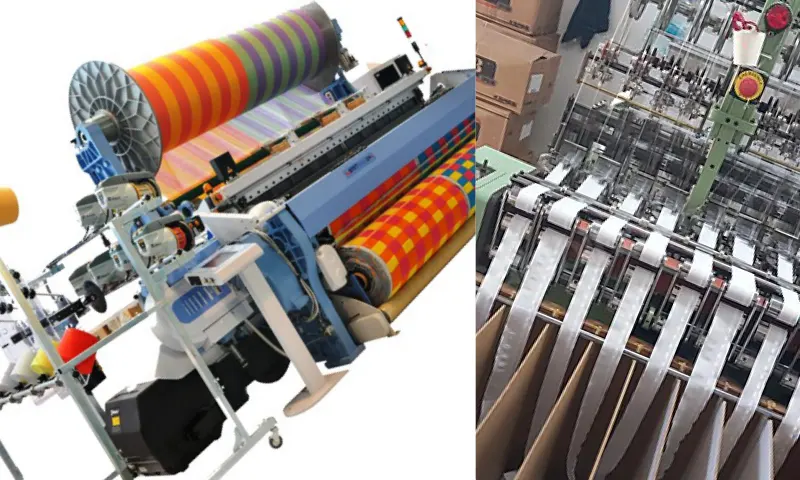
Fabric weaving machines work by interlacing two groups of yarns: warp yarns and weft yarns. These machines have different working principles and types. Here are the main types of weaving machines and their working principles:
- Plain Weaving Machines: Plain weaving machines are the most commonly used weaving machines. In these machines, warp yarns are placed vertically, and weft yarns are woven horizontally. Plain weaving machines are used in the production of basic plain and patterned fabrics. These machines have various subtypes, such as jacquard looms, which enable the weaving of simple and complex patterns.
- Pile Weaving Machines: Pile weaving machines are used especially in the production of fuzzy fabrics such as towels and plush. In these machines, an extra set of yarns is used to add a fuzzy surface to the fabric. Pile weaving machines produce different types of fuzzy fabrics by controlling pile height and density.
- Circular Weaving Machines: Circular weaving machines are machines that operate with circular motions and produce tubular fabric. These machines are used especially in the production of socks, t-shirts, and other circular knit fabrics. Circular weaving machines have the capacity for high-speed and continuous production.
The Importance and Future of Fabric Weaving Machines in the Textile Industry
Fabric weaving machines are an indispensable part of the textile industry. These machines not only increase production speed but also significantly enhance quality and variety. The future of weaving machines will continue to be shaped by technology and innovations.
- Efficiency and Production Speed: Modern weaving machines have the capacity to produce large quantities of fabric at high speeds. This enables the textile industry to produce the high volumes of fabric demanded quickly and efficiently. At the same time, automation and programmable systems minimize human error and improve production quality.
- Quality and Variety: Weaving machines have the ability to produce fabrics in different patterns and qualities. This increases the diversity of textile products and allows the fashion industry to respond quickly to changing demands. High-quality and complex patterns can be produced more easily and precisely with modern weaving machines.
- Future and Technological Innovations: The future of weaving machines will be shaped by technology and innovations. Industry 4.0 and smart manufacturing systems will make weaving machines smarter and more efficient. The integration of robotics and artificial intelligence will further automate weaving processes, increasing production speed and quality. Furthermore, environmentally friendly and sustainable production techniques will play a significant role in weaving machines in the future.
Fabric weaving machines are one of the cornerstones of the textile industry, increasing the efficiency, speed, and quality of the production process. Having undergone a great evolution throughout history, these machines will continue to develop with technological innovations in the future.