How is a Tasseled Imamah Made?
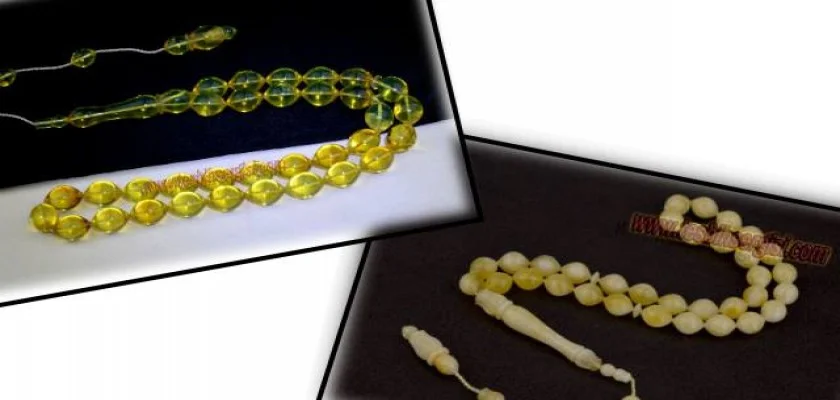
The rosary, which expresses that everything in the universe praises God, is manufactured using materials from 5 different continents. The material used in rosary making must be suitable for the lathe. Rosaries are made perfectly by paying attention to every detail in the material used and during the manufacturing stage, which can be made from precious and semi-precious stones, animal substances, marine and fossil-origin materials, wood, plant, and synthetic materials. Precious and semi-precious substances such as emerald, diamond, ruby, turquoise, necef, crystal, shahmaksud, lapis lazuli, agate, and star stone are used. Rosaries made from a wide variety of animal materials, as well as precious stones, are also quite striking. They are especially made from elephant ivory, mammoth ivory, whale ivory, hippopotamus ivory, walrus ivory, sea turtle shell, rhinoceros and buffalo horn, gazelle, deer, and wild goat horn, and amber. The imamah section, to which rosary artisans pay special attention, is the detail at the point where the string holding the beads joins. The tasseled imamah, which is admired and especially preferred by everyone, requires fine craftsmanship. The imamah, the most magnificent part where rosary makers display their art, is designed to be 4-6 times longer than the bead length. Rings that require special effort are made in the knotted parts of the imamah. Amber rosaries made with a tasseled imamah are striking with their very chic posture and elegant appearance.
What Parts Does a Rosary Consist Of?
One of the main parts that make up a rosary is the beads, called 'habbe'. These beads, which require special craftsmanship to make, are made with a diameter of 4-11 mm. This amber rosary with small beads, called 'Zenne- Women's Rosary', is also designed with different aesthetic carvings, fantasy shapes, and various forms. They are generally made in round, spherical, turnip, oval, and cylindrical shapes. Those made with larger beads are used for collection purposes. In 99-bead rosaries, the marker, called 'muezzin', placed after the 33rd and 66th beads, is a bead that hangs outward and resembles a flat lentil. Apart from this section, also called 'pul' and 'durak', there are also parts consisting of the imamah, knot holder, hatime, coin, and tassel.
www.tesbihsergisi.com